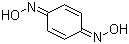
Rubber can be crosslinked without relying only on elemental sulfur. 1,4-Benzoquinone dioxime, CAS 105-11-3, became important because quinone oxime chemistry offered another route to forming networks in elastomers. The compound is the dioxime of p-benzoquinone, and under vulcanization conditions it can participate in oxidation and conversion to highly reactive nitroso-type species that promote crosslinking, especially in unsaturated rubbers.
The historical setting is important. Vulcanization transformed natural rubber from a sticky, temperature-sensitive material into a resilient engineering material by tying polymer chains together. Sulfur systems dominated, but not every formulation wanted the same cure rate, heat resistance, adhesion, or electrical properties. Quinone dioxime systems were developed as alternative curing chemistry and were particularly associated with rapid cures, hard rubber formulations, and bonding applications involving rubber and reinforcing materials.
1,4-Benzoquinone dioxime is often discussed together with oxidizing agents such as lead oxides in older rubber technology. The oxidant converts the oxime toward p-dinitrosobenzene or related reactive intermediates, which can add to unsaturated polymer chains and create carbon-nitrogen-containing crosslinks. The exact network chemistry depends on polymer, formulation, temperature, and coagents, so it is more accurate to view the reagent as part of a curing system than as a single-step crosslinker with one universal mechanism.
That older technology also illustrates how industrial chemistry changes as toxicology and regulation evolve. Historical rubber recipes frequently used lead compounds because they gave useful curing and bonding performance, but modern practice must account for the well-established hazards of lead and for worker exposure to reactive curing chemicals. IARC and the U.S. National Toxicology Program have evaluated 1,4-benzoquinone dioxime in the context of occupational use and toxicological evidence, making it an example in which process performance and health protection cannot be separated.
The chemistry remains conceptually valuable even where specific historical formulations are no longer preferred. It shows that 'vulcanization' is not synonymous with adding sulfur. The essential task is to create controlled bridges between long polymer chains so that they can no longer flow independently. Sulfur, peroxides, resins, metal oxides, and quinone-derived systems accomplish that goal through different reaction pathways and produce different network structures.
What makes 1,4-benzoquinone dioxime memorable is therefore its place in the evolution of crosslinking chemistry. A small aromatic molecule helped chemists tune the macroscopic behavior of rubber by changing how polymer chains were connected. At the same time, its history reminds us that a technically effective cure system must eventually be judged by processing safety and toxicology as well as by modulus and cure speed.
References:
1. International Agency for Research on Cancer (IARC). 1,4-Benzoquinone dioxime monograph and occupational use information.
2. U.S. National Toxicology Program. Toxicology and carcinogenesis studies of p-quinone dioxime, Technical Report 179; NTP data DOI: 10.22427/NTP-DATA-DTXSID8021222.
3. Akiba M., Hashim A.S. Vulcanization and crosslinking in elastomers. Progress in Polymer Science. 1997, 22, 475-521. DOI: 10.1016/S0079-6700(96)00015-9.
4. Coran A.Y. Vulcanization. In: The Science and Technology of Rubber. DOI: 10.1016/B978-0-12-394584-6.00007-8.
|








 GHS07;GHS08 Warning Details
 chemBlink Chemical Story