
Online Database of Chemicals from Around the World
| Sigma-Aldrich, Inc. | China | |||
|---|---|---|---|---|
 | www.sigmaaldrich.com | |||
 | +86 (21) 6141-5566 800-819-3336 | |||
 | orderCN@sial.com | |||
| Chemical manufacturer since 1992 | ||||
| chemBlink Standard supplier since 2013 | ||||
| Hangzhou Leap Chem Co., Ltd. | China | |||
|---|---|---|---|---|
| www.leapchem.com | |||
| +86 (571) 8771-1850 | |||
| market19@leapchem.com | |||
 | QQ Chat | |||
| Chemical manufacturer since 2006 | ||||
| chemBlink Standard supplier since 2015 | ||||
| Wuhan Carnoss Technology Co., Ltd. | China | |||
|---|---|---|---|---|
| www.carnoss.com | |||
| +86 18064039730 | |||
 | +86 (27) 8349-6462 | |||
| frank@carnosschem.com | |||
 | WeChat: kanuosi_wxid | |||
| Chemical manufacturer since 2012 | ||||
| chemBlink Standard supplier since 2018 | ||||
| Nanjing Qiangshan New Material Co., Ltd. | China | |||
|---|---|---|---|---|
| www.njqschem.com | |||
| +86 (25) 5702-7223 | |||
| dols80@163.com | |||
| Chemical distributor since 2011 | ||||
| chemBlink Standard supplier since 2020 | ||||
| Mendel Chemicals | Moldova | |||
|---|---|---|---|---|
| www.mendelchemicals.com | |||
| +373 78813683 | |||
| info@mendelchemicals.com | |||
 | WhatsApp:+37378813683 | |||
| Chemical manufacturer since 2020 | ||||
| chemBlink Standard supplier since 2024 | ||||
| Classification | Chemical reagent >> Organic reagent >> Halogenated aliphatic hydrocarbon |
|---|---|
| Name | Decanedioyl dichloride |
| Synonyms | Decanedioic acid dichloride; Decanedioic dichloride; Decanedioyl chloride; NSC 56763; Sebacic acid chloride; Sebacic acid dichloride; Sebacic dichloride; Sebacoyl dichloride; Sebacyl chloride |
| Molecular Structure | 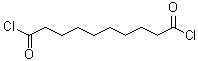 |
| Molecular Formula | C10H16Cl2O2 |
| Molecular Weight | 239.14 |
| CAS Registry Number | 111-19-3 |
| EC Number | 203-843-4 |
| SMILES | C(CCCCC(=O)Cl)CCCC(=O)Cl |
| Solubility | Very slightly soluble (0.41 g/L) (25 °C), Calc.* |
|---|---|
| Density | 1.1±0.1 g/cm3 Calc.*, 1.121 g/mL (Expl.) |
| Melting point | -5 - -3 °C (Expl.) |
| Boiling point | 306.1 °C 760 mmHg (Calc.)*, 337.2 °C (Expl.) |
| Flash point | 151.4±21.2 °C (Calc.)*, 113 °C (Expl.) |
| Index of refraction | 1.464 (Calc.)*, 1.468 (Expl.) |
| * | Calculated using Advanced Chemistry Development (ACD/Labs) Software. |
| Hazard Symbols |   GHS05;GHS07 Danger Details GHS05;GHS07 Danger Details | ||||||||||||||||||||||||||||||||||||
|---|---|---|---|---|---|---|---|---|---|---|---|---|---|---|---|---|---|---|---|---|---|---|---|---|---|---|---|---|---|---|---|---|---|---|---|---|---|
| Risk Statements | H302-H314 Details | ||||||||||||||||||||||||||||||||||||
| Safety Statements | P260-P264-P270-P280-P301+P317-P301+P330+P331-P302+P361+P354-P304+P340-P305+P354+P338-P316-P321-P330-P363-P405-P501 Details | ||||||||||||||||||||||||||||||||||||
| Hazard Classification | |||||||||||||||||||||||||||||||||||||
| |||||||||||||||||||||||||||||||||||||
| SDS | Available | ||||||||||||||||||||||||||||||||||||
 chemBlink Chemical Story
|
Sebacoyl chloride is famous in classrooms because it can make a piece of nylon appear almost instantly at the boundary between two liquids. The reaction often called the nylon rope trick uses sebacoyl chloride in an organic phase and hexamethylenediamine in water. Where the two phases touch, the acid chloride and amine react rapidly to form amide bonds. Pull the thin polymer film away from the interface and fresh liquid meets fresh liquid, allowing a continuous nylon 6,10 filament to be drawn. The demonstration is visually striking, but the chemistry behind it is industrially important. Sebacoyl chloride is the diacid chloride derived from sebacic acid. Converting carboxylic acid groups into acid chlorides makes the carbonyl carbons much more electrophilic. Amines therefore attack quickly, chloride leaves, and each end of the molecule can connect to a different diamine molecule. Repetition creates a polyamide chain, while hydrogen chloride is generated and must be neutralized or removed. Interfacial polymerization solves a practical kinetic problem. The two monomers need not be soluble in the same liquid. Each can be placed in the phase that suits it, and reaction is confined to a very thin boundary. Because polymer forms where monomers encounter each other, diffusion continually feeds the growing film. This principle became important far beyond a classroom beaker, including thin polyamide barriers, microcapsules, coatings, and specialized composite structures. Modern research shows how adaptable the idea can be. Mitchell and co-workers used interfacial/emulsion polymerization involving sebacoyl chloride and hexamethylenediamine to coat individual single-walled carbon nanotubes with nylon 6,10. Instead of drawing a visible fiber by hand, the same rapid amide-forming chemistry was directed around nanoscale objects. Other studies have used sebacoyl chloride in polyamide microcapsules, where a polymer shell forms around droplets and controls permeability or release. The length of sebacoyl chloride also matters. Its eight methylene groups place a flexible hydrophobic spacer between the two acid chloride groups. Nylon 6,10 therefore differs from shorter, more densely amide-rich polyamides in water uptake, flexibility, melting behavior, and intermolecular hydrogen bonding. Polymer properties emerge not only from the amide bond but from the spacing between amide bonds along the chain. Sebacoyl chloride is memorable because it makes a normally invisible concept visible: a chemical interface can be a reactor. Two monomers that live in different liquids meet only at a boundary a fraction of a millimeter thick, yet that boundary can continuously manufacture a strong polymer. The nylon rope trick is not merely a demonstration; it is a compact model of how reaction engineering and molecular design can work together. References: 1. Mitchell C.A. et al. Coating individual single-walled carbon nanotubes with nylon 6,10 through emulsion polymerization. ACS Applied Materials & Interfaces. 2009, 1, 1821-1826. DOI: 10.1021/am900369g. 2. Journal of Membrane Science. Polyamide microcapsules prepared by interfacial polymerization. 2001. DOI: 10.1016/S0376-7388(01)00385-4. 3. Marques et al. Polyamide microcapsules using interfacial polymerization. DOI: 10.3109/02652048.2015.1028494. 4. Standard polymer chemistry literature on nylon 6,10 and interfacial polycondensation. |
| Market Analysis Reports |