
Online Database of Chemicals from Around the World
| Targetmol China | China | |||
|---|---|---|---|---|
 | www.targetmol.cn | |||
 | +86 (400) 820-0310 | |||
 | sales@targetmol.cn | |||
| Chemical manufacturer since 2015 | ||||
| chemBlink Standard supplier since 2025 | ||||
| Classification | API >> Circulatory system medication >> Beta-adrenergic receptor blocker |
|---|---|
| Name | disodium (R,R)-5-(2-((2-(3-chlorophenyl)-2-hydroxyethyl)-amino)propyl)-1,3-benzodioxole-2,3-dicarboxylate |
| Synonyms | CL 316243 |
| Molecular Structure | 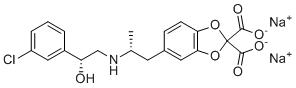 |
| Molecular Formula | C20H18ClNNa2O7 |
| Molecular Weight | 465.79 |
| CAS Registry Number | 138908-40-4 |
| SMILES | C[C@H](CC1=CC2=C(C=C1)OC(O2)(C(=O)[O-])C(=O)[O-])NC[C@@H](C3=CC(=CC=C3)Cl)O.[Na+].[Na+] |
| Solubility | Soluble 100 mM in water (Expl.) |
|---|---|
| Hazard Symbols |  GHS07 Warning Details GHS07 Warning Details |
|---|---|
| Risk Statements | H302-H315-H319-H335 Details |
| Safety Statements | P261-P280-P301+P312-P302+P352-P305+P351+P338 Details |
| SDS | Available |
 chemBlink Chemical Story
|
Disodium (R,R)-5-(2-((2-(3-chlorophenyl)-2-hydroxyethyl)amino)propyl)-1,3-benzodioxole-2,3-dicarboxylate is a chemically well-defined compound characterized by a benzodioxole core substituted with dicarboxylate groups and a chiral side chain containing a 3-chlorophenyl moiety and hydroxyethylamino functionality. The compound’s structure includes two sodium ions balancing the negative charges of the dicarboxylate groups, enhancing its solubility in aqueous environments. The discovery of this compound is linked to synthetic efforts aimed at developing biologically active molecules, often as intermediates or candidates in pharmaceutical research. The presence of the benzodioxole ring system, a motif frequently encountered in natural products and bioactive synthetic molecules, suggests potential applications related to enzyme inhibition, receptor binding, or modulation of biological pathways. The chiral (R,R) configuration indicates stereospecific synthesis or resolution, which is crucial for bioactivity and pharmacological properties, as enantiomers can differ significantly in their interaction with biological targets. This compound’s applications mainly pertain to medicinal chemistry, where it can serve as a building block or active agent in drug design. The combination of a chlorophenyl group, hydroxyethylamine linkage, and dicarboxylate substitution offers multiple points for interaction with biomolecules, potentially contributing to selectivity and potency in targeting enzymes, receptors, or transport proteins. The disodium salt form improves water solubility and bioavailability, essential for drug formulation and delivery. In biochemical research, such compounds are valuable for studying structure-activity relationships, enabling researchers to investigate how modifications to the chemical structure affect biological activity. This understanding can guide the optimization of lead compounds in drug discovery. Additionally, the compound’s stereochemistry allows for exploration of enantioselective effects in biological systems. Overall, disodium (R,R)-5-(2-((2-(3-chlorophenyl)-2-hydroxyethyl)amino)propyl)-1,3-benzodioxole-2,3-dicarboxylate represents a chemically sophisticated molecule with relevance in pharmaceutical research, particularly in the design and development of bioactive agents. Its discovery stems from targeted synthetic chemistry efforts, and its applications lie primarily in medicinal chemistry and biochemical investigations. References 1994. Beta-3 adrenoceptor-mediated increase in cutaneous blood flow in the dog. The Journal of Pharmacology and Experimental Therapeutics, 268(3). URL: https://pubmed.ncbi.nlm.nih.gov/7908057 1994. Effect of CL-316,243, a thermogenic beta 3-agonist, on energy balance and brown and white adipose tissues in rats. American Journal of Physiology-Regulatory, Integrative and Comparative Physiology, 266(4). DOI: 10.1152/ajpregu.1994.266.4.r1371 2024. Chronic β3-AR stimulation activates distinct thermogenic mechanisms in brown and white adipose tissue and improves systemic metabolism in aged mice. Aging Cell, 23(10). DOI: 10.1111/acel.14321 |
| Market Analysis Reports |