
Online Database of Chemicals from Around the World
| Hefei TNJ Chemical Industry Co., Ltd. | China | |||
|---|---|---|---|---|
 | www.tnjchem.com | |||
 | +86 (551) 6541-8684 | |||
 | +86 (551) 6541-8697 | |||
 | sales@tnjchem.com | |||
| Chemical manufacturer since 2001 | ||||
| chemBlink Standard supplier since 2010 | ||||
| BOC Sciences | USA | |||
|---|---|---|---|---|
| www.bocsci.com | |||
| +1 (631) 485-4226 | |||
| +1 (631) 614-7828 | |||
| info@bocsci.com | |||
| Chemical manufacturer | ||||
| chemBlink Standard supplier since 2010 | ||||
| Hangzhou Leap Chem Co., Ltd. | China | |||
|---|---|---|---|---|
| www.leapchem.com | |||
| +86 (571) 8771-1850 | |||
| market19@leapchem.com | |||
 | QQ Chat | |||
| Chemical manufacturer since 2006 | ||||
| chemBlink Standard supplier since 2015 | ||||
| Neostar United (Changzhou) Industrial Co., Ltd. | China | |||
|---|---|---|---|---|
| www.neostarunited.com | |||
| +86 (519) 8555-7386 +86 18015025600 | |||
| +86 (519) 8555-7389 | |||
| marketing1@neostarunited.com | |||
| Chemical distributor since 2014 | ||||
| chemBlink Standard supplier since 2020 | ||||
| Chem Service, Inc. | USA | |||
|---|---|---|---|---|
| www.chemservice.com | |||
| +1 (610) 692-3026 | |||
| +1 (610) 692-8729 | |||
| info@chemservice.com | |||
| Chemical manufacturer since 1962 | ||||
| AccuStandard Inc. | USA | |||
|---|---|---|---|---|
| www.accustandard.com | |||
| +1 (203) 786-5290 | |||
| +1 (203) 786-5287 | |||
| orders@accustandard.com | |||
| Chemical manufacturer since 1986 | ||||
| Jurong Renxin Chemical Co., Ltd. | China | |||
|---|---|---|---|---|
| www.jrxchem.com | |||
| +86 (519) 8222-0712 +86 13901490712 | |||
| +86 (519) 8821-8921 | |||
| sales@jrxchem.com | |||
| Chemical manufacturer | ||||
| Crescent Chemical Co. Inc. | USA | |||
|---|---|---|---|---|
| www.crescentchemical.com | |||
| +1 (631) 348-0333 | |||
| +1 (631) 348-0913 | |||
| crescent@creschem.com | |||
| Chemical distributor | ||||
| Shanghai Worldyang Chemical Co., Ltd. | China | |||
|---|---|---|---|---|
| www.worldyachem.com | |||
| +86 13651600618 +86 (21) 5679-5779 | |||
| +86 (21) 5679-5266 | |||
| sales7777@worldyachem.com | |||
| QQ Chat | |||
 | WeChat: 13651600618 | |||
 | WhatsApp:+86 13651600618 | |||
| Chemical manufacturer since 2012 | ||||
| Tide Group Co., Ltd. | China | |||
|---|---|---|---|---|
| www.tide-china.com | |||
| +86 (571) 8527-0003 8993-7766 8993-7788 | |||
| +86 (571) 8527-0005 / 8993-7770 | |||
| info@tide-china.com | |||
| Chemical distributor since 2003 | ||||
| LKT Laboratories, Inc. | USA | |||
|---|---|---|---|---|
| www.lktlabs.com | |||
| +1 (888) 558-5227 | |||
| +1 (651) 644-8357 | |||
| peacerli@mbolin-lktlabs.com | |||
| Chemical manufacturer | ||||
| Classification | Food additive >> Preservative |
|---|---|
| Name | Imazalil |
| Synonyms | 1-[2-(2,4-Dichloro-phenyl)-2-(2-propenyloxy)ethyl]-1H-imidazole; 1-[2-(Allyloxy)-2-(2,4-dichlorophenyl)ethyl]imidazole |
| Molecular Structure | 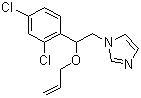 |
| Molecular Formula | C14H14Cl2N2O |
| Molecular Weight | 297.18 |
| CAS Registry Number | 35554-44-0 |
| EC Number | 252-615-0 |
| SMILES | C=CCOC(CN1C=CN=C1)C2=C(C=C(C=C2)Cl)Cl |
| Density | 1.348 |
|---|---|
| Melting point | 52.7 °C |
| Boiling point | >340 °C |
| Water solubility | 0.018 g/100 mL |
| Hazard Symbols |     GHS06;GHS08;GHS05;GHS09 Details GHS06;GHS08;GHS05;GHS09 Details | ||||||||||||||||||||||||||||||||||||||||
|---|---|---|---|---|---|---|---|---|---|---|---|---|---|---|---|---|---|---|---|---|---|---|---|---|---|---|---|---|---|---|---|---|---|---|---|---|---|---|---|---|---|
| Risk Statements | H301-H318-H332-H351-H410 Details | ||||||||||||||||||||||||||||||||||||||||
| Safety Statements | P202-P273-P280-P301+P310-P304+P340+P312-P305+P351+P338 Details | ||||||||||||||||||||||||||||||||||||||||
| Hazard Classification | |||||||||||||||||||||||||||||||||||||||||
| |||||||||||||||||||||||||||||||||||||||||
| SDS | Available | ||||||||||||||||||||||||||||||||||||||||
 chemBlink Chemical Story
|
Imazalil is a synthetic fungicide belonging to the class of imidazole derivatives. Chemically, it is known as (RS)-1-(β-allyloxy-2,4-dichlorophenethyl)-1H-imidazole. The compound features an imidazole ring attached to a substituted phenethyl moiety bearing two chlorine atoms and an allyloxy group. Imazalil is primarily used as a post-harvest treatment to control fungal diseases on fruits and vegetables. The discovery of imazalil dates back to the 1970s when it was developed to provide effective protection against a broad spectrum of pathogenic fungi, including species responsible for storage rot such as Penicillium, Botrytis, and Alternaria. Its development responded to the need for fungicides with improved efficacy and safety profiles compared to older compounds. Imazalil functions by inhibiting the biosynthesis of ergosterol, an essential component of fungal cell membranes. It achieves this by targeting the enzyme lanosterol 14α-demethylase, a member of the cytochrome P450 family. The inhibition disrupts membrane integrity and fungal growth, leading to fungistatic or fungicidal effects depending on the concentration and exposure time. In agricultural applications, imazalil is widely employed as a post-harvest dip, spray, or coating to prevent spoilage and extend shelf life, especially on citrus fruits like oranges, lemons, and grapefruits. It is effective against green mold (caused by Penicillium digitatum), blue mold (Penicillium italicum), and other storage fungi. The fungicide reduces post-harvest losses and maintains fruit quality during storage and transport. Besides post-harvest use, imazalil has limited applications as a foliar fungicide in some crops, although its primary value remains in storage protection. Formulations typically include emulsifiable concentrates or wettable powders that facilitate application and adherence to produce surfaces. The compound’s chemical stability, low volatility, and lipophilicity contribute to its persistence on treated produce, ensuring prolonged protective effects. However, imazalil is subject to regulation and maximum residue limits in food products to minimize consumer exposure and environmental impact. Toxicologically, imazalil exhibits moderate acute toxicity. Safety measures during handling and application include protective clothing and adherence to recommended usage guidelines. Environmental assessments have noted potential effects on aquatic organisms, and thus usage near water bodies is carefully managed. Resistance development in fungal populations has been reported with prolonged use of imazalil, necessitating integrated pest management strategies that combine fungicides with different modes of action and cultural controls to delay resistance onset. Analytical methods such as high-performance liquid chromatography (HPLC) coupled with mass spectrometry are used to monitor imazalil residues in food products and environmental samples, ensuring compliance with safety standards. In summary, imazalil is an imidazole-based fungicide extensively used for post-harvest disease control on fruits, especially citrus. Its mode of action involves inhibition of fungal ergosterol biosynthesis, leading to effective suppression of storage fungi. Despite challenges with resistance, it remains an important tool in maintaining agricultural produce quality worldwide. References 2024. Enantioselective Degradation Behavior and Influencing Factors of Chiral Imazalil in Different Soils. Journal of Soil Science and Plant Nutrition, 24(3). DOI: 10.1007/s42729-024-02051-x 2024. Study on the use of Imazalil to continuous cropping obstacle of Ganoderma lucidum caused by Xylogone ganodermophthora. Chemical and Biological Technologies in Agriculture, 11(1). DOI: 10.1186/s40538-024-00584-y 2024. Advances on multiclass pesticide residue determination in citrus fruits and citrus-derived products - A critical review. Environmental science and pollution research international, 31(34). DOI: 10.1007/s11356-024-34525-x |
| Market Analysis Reports |