
Online Database of Chemicals from Around the World
| Shanghai PI Chemicals Ltd. | China | |||
|---|---|---|---|---|
 | www.pipharm.com | |||
 | +86 (21) 58953700 | |||
 | +86 (21) 58953701 | |||
 | sales@pipharm.com | |||
| Chemical distributor since 2007 | ||||
| chemBlink Standard supplier since 2026 | ||||
| Classification | Organic raw materials >> Alcohols, phenols, phenolic compounds and derivatives |
|---|---|
| Name | 17-Amino-3,6,9,12,15-pentaoxaheptadecanol |
| Synonyms | 2-[2-[2-[2-[2-(2-aminoethoxy)ethoxy]ethoxy]ethoxy]ethoxy]ethanol |
| Molecular Structure | 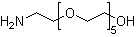 |
| Molecular Formula | C12H27NO6 |
| Molecular Weight | 281.35 |
| CAS Registry Number | 39160-70-8 |
| EC Number | 828-877-2 |
| SMILES | C(COCCOCCOCCOCCOCCO)N |
| Solubility | Freely soluble (999 g/L) (25 °C), Calc.* |
|---|---|
| Density | 1.083±0.06 g/cm3 (20 °C 760 Torr), Calc.* |
| Boiling point | 388.0±37.0 °C 760 mmHg (Calc.)* |
| Flash point | 188.5±26.5 °C (Calc.)* |
| Index of refraction | 1.463 (Calc.)* |
| * | Calculated using Advanced Chemistry Development (ACD/Labs) Software. |
| Hazard Symbols |  GHS07 Warning Details | ||||||||||||||||
|---|---|---|---|---|---|---|---|---|---|---|---|---|---|---|---|---|---|
| Risk Statements | H315-H319-H335 Details | ||||||||||||||||
| Safety Statements | P261-P264-P264+P265-P271-P280-P302+P352-P304+P340-P305+P351+P338-P319-P321-P332+P317-P337+P317-P362+P364-P403+P233-P405-P501 Details | ||||||||||||||||
| Hazard Classification | |||||||||||||||||
| |||||||||||||||||
| SDS | Available | ||||||||||||||||
 chemBlink Chemical Story
|
17-Amino-3,6,9,12,15-pentaoxaheptadecanol is a short, defined chain with a primary amine at one end and a primary alcohol at the other. Five oxygens occupy internal ether positions, and a sixth belongs to the terminal hydroxyl. The same material is commonly called Amino-PEG6-alcohol or 1-aminohexaethylene glycol. These names count different features: the word pentaoxa identifies five ether oxygens, while PEG6 describes the ethylene-based chain convention. The unequal termini provide the useful chemical distinction. An amine and an alcohol have different acid–base behavior and different preferences in coupling chemistry. A suitable acylating reagent can be used to form an amide at an available amine, while the alcohol may be preserved for a later transformation if the conditions are compatible. This is a functional-group rationale, not a guarantee of perfect selectivity for every substrate. Protonation adds another layer. The terminal amine can carry positive charge under appropriate solution conditions. That changes the species present without altering the number of ether units in the chain. A depiction of the neutral parent therefore should not be interpreted as a claim that the material has one charge state at every pH. The alcohol and ethers do not share the same protonation behavior as the amine. The intervening chain also allows conformational freedom. Its oxygen atoms offer hydrogen-bond acceptor sites, but a picture stretched across a page does not prescribe how the ends are arranged in solution. Adding this segment to another molecule changes composition and connectivity; the properties of the resulting conjugate still depend on both partners and the complete structure. The accessible records support its identity as a chemical reagent more clearly than an independent biological application. The most useful account is consequently one of asymmetric construction: an amino end, an alcohol end and a specified chain between them. It should not be confused with an amino-PEG acid, whose second terminus has different atoms and reactivity, or described as a complete protein degrader merely because such linkers appear in synthetic research catalogs. References: 1. PubChem. Amino-PEG6-alcohol, CID 20554065. https://pubchem.ncbi.nlm.nih.gov/compound/20554065 2. TargetMol. Amino-PEG6-alcohol, CAS 39160-70-8, SDS T14247. https://static.cymitquimica.com/products/TM/pdf/sds-T14247.pdf |
| Market Analysis Reports |