
Online Database of Chemicals from Around the World
| Simagchem Corporation | China | |||
|---|---|---|---|---|
 | www.simagchem.com | |||
 | +86 13806087780 | |||
 | +86 (592) 268-0237 | |||
 | sale@simagchem.com | |||
| Chemical manufacturer since 2002 | ||||
| chemBlink Standard supplier since 2008 | ||||
| Hefei TNJ Chemical Industry Co., Ltd. | China | |||
|---|---|---|---|---|
| www.tnjchem.com | |||
| +86 (551) 6541-8684 | |||
| +86 (551) 6541-8697 | |||
| sales@tnjchem.com | |||
| Chemical manufacturer since 2001 | ||||
| chemBlink Standard supplier since 2010 | ||||
| Zhangjiagang Clent Chemical Co., Ltd. | China | |||
|---|---|---|---|---|
| www.clentchem.com | |||
| +86 (512) 5881-3106 +86 13962460297 | |||
| +86 (512) 5881-2106 | |||
| sales@clentchem.com | |||
 | QQ Chat | |||
| Chemical manufacturer | ||||
| chemBlink Standard supplier since 2012 | ||||
| Hangzhou Leap Chem Co., Ltd. | China | |||
|---|---|---|---|---|
| www.leapchem.com | |||
| +86 (571) 8771-1850 | |||
| market19@leapchem.com | |||
| QQ Chat | |||
| Chemical manufacturer since 2006 | ||||
| chemBlink Standard supplier since 2015 | ||||
| Wuhan Carnoss Technology Co., Ltd. | China | |||
|---|---|---|---|---|
| www.carnoss.com | |||
| +86 18064039730 | |||
| +86 (27) 8349-6462 | |||
| frank@carnosschem.com | |||
 | WeChat: kanuosi_wxid | |||
| Chemical manufacturer since 2012 | ||||
| chemBlink Standard supplier since 2018 | ||||
| Classification | Chemical reagent >> Organic reagent >> Ether |
|---|---|
| Name | Isosorbide dimethyl ether |
| Synonyms | DMI; 1,4:3,6-Dianhydro-2,5-di-O-methyl-D-glucitol |
| Molecular Structure | 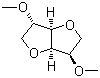 |
| Molecular Formula | C8H14O4 |
| Molecular Weight | 174.19 |
| CAS Registry Number | 5306-85-4 |
| EC Number | 226-159-8 |
| SMILES | CO[C@@H]1CO[C@H]2[C@@H]1OC[C@@H]2OC |
| Density | 1.2±0.1 g/cm3 Calc.*, 1.165 g/mL (Expl.) |
|---|---|
| Melting point | -70 °C (Expl.) |
| Boiling point | 236.4±40.0 °C 760 mmHg (Calc.)*, 393.1 - 396.6 °C (Expl.) |
| Flash point | 108.3 °C (Calc.)*, 108 °C (Expl.) |
| Index of refraction | 1.466 (Calc.)*, 1.463 (Expl.) |
| * | Calculated using Advanced Chemistry Development (ACD/Labs) Software. |
| Hazard Symbols |  GHS07 Warning Details GHS07 Warning Details | ||||||||
|---|---|---|---|---|---|---|---|---|---|
| Risk Statements | H302-H315-H319-H335 Details | ||||||||
| Safety Statements | P261-P305+P351+P338 Details | ||||||||
| Hazard Classification | |||||||||
| |||||||||
| SDS | Available | ||||||||
 chemBlink Chemical Story
|
Isosorbide dimethyl ether, widely called dimethyl isosorbide or DMI, represents a modern idea with old raw materials: build useful solvents from carbohydrates instead of petroleum. Isosorbide is obtained by dehydration of sorbitol, itself produced from glucose. Methylating the two hydroxyl groups gives DMI, a bicyclic diether whose rigid oxygen-rich framework combines substantial polarity with the absence of strongly hydrogen-bond-donating OH groups. This combination gives DMI unusual solvent behavior. It can dissolve a range of polar and moderately nonpolar compounds, has a relatively high boiling point, and is used as a specialty solvent or cosolvent in synthesis, cosmetics, and pharmaceutical formulation. Because it lacks the free hydroxyl groups of isosorbide, it is less self-associated and often provides better solubilization for hydrophobic ingredients than the parent diol. Its compact bicyclic skeleton also distinguishes it from flexible glycol ethers. DMI has attracted renewed interest in green chemistry because its carbon framework can be traced to renewable carbohydrate feedstocks. Researchers have evaluated it as an alternative medium for reactions that commonly rely on polar aprotic solvents such as NMP or DMF. Examples include palladium-catalyzed cross-coupling and nickel-catalyzed reductive coupling. Calling a solvent "bio-based" does not automatically make every use sustainable, but renewable origin, toxicity profile, boiling point, recyclability, and process performance can be evaluated together. The molecule also shows that green-solvent selection is a systems problem. A high-boiling solvent may reduce volatile emissions during use but require more energy for distillation. Excellent solvating power may reduce solvent volume yet complicate product isolation. A renewable feedstock may improve carbon sourcing while synthesis and methylation still consume reagents and energy. DMI is valuable precisely because it invites these comparisons rather than because one label settles the question. The rigid fused-ring structure also gives isosorbide chemistry a stereochemical identity that flexible polyols lack. Its two oxygen bridges lock the framework into a defined three-dimensional shape, and the two substituent positions are not simply equivalent to hydroxyls on an open chain. Derivatization can therefore produce solvents, monomers, plasticizers, and pharmaceutical intermediates with properties inherited from this constrained geometry. DMI is one branch of a much larger effort to turn isosorbide into a renewable platform chemical rather than treating sorbitol only as a food ingredient. What makes DMI memorable is the transformation of sugar chemistry into solvent design. Glucose can be reduced to sorbitol, dehydrated to the rigid bicyclic isosorbide core, and methylated to remove hydrogen-bond donation while retaining several ether oxygens. The result is not simply a derivative of a sweetener. It is a deliberately tuned solvent platform showing how biomass-derived molecular skeletons can compete in applications once dominated by petrochemical solvents. References: 1. Rose M, Palkovits R. ChemSusChem. 2012;5:167-176. DOI: 10.1002/cssc.201100580. 2. Wilson KL et al. Dimethylisosorbide as a bio-derived solvent for Pd-catalyzed cross-coupling reactions. Synlett. 2018;29:2293-2297. 3. Organic Letters. 2022. Nickel-catalyzed reductive cross-coupling in dimethyl isosorbide. 4. Sigma-Aldrich technical information for dimethyl isosorbide, CAS 5306-85-4. |
| Market Analysis Reports |