
Online Database of Chemicals from Around the World
| Qingdao Free Trade Zone United International Co., Ltd. | China | |||
|---|---|---|---|---|
 | www.unitedint.com | |||
 | +86 (532) 83893696 +86 13808950921 | |||
 | +86 (532) 8389-3695 | |||
 | jason.wang@unitedint.com | |||
 | QQ Chat | |||
| Chemical distributor | ||||
| chemBlink Standard supplier since 2006 | ||||
| Zhejiang Chemicals Import & Export Corporation | China | |||
|---|---|---|---|---|
| www.zhechem.com | |||
| +86 (571) 8704-3117 8704-9996 | |||
| +86 (571) 8704-6240 | |||
| info@zhechem.com | |||
| Chemical distributor | ||||
| chemBlink Standard supplier since 2007 | ||||
| Baoji Herbest Bio-tech Co., Ltd. | China | |||
|---|---|---|---|---|
| www.herbest.cn | |||
| +86 (917) 888-1635 | |||
| root@herbest.cn | |||
| QQ Chat | |||
| Chemical manufacturer since 2008 | ||||
| chemBlink Standard supplier since 2008 | ||||
| Simagchem Corporation | China | |||
|---|---|---|---|---|
| www.simagchem.com | |||
| +86 13806087780 | |||
| +86 (592) 268-0237 | |||
| sale@simagchem.com | |||
| Chemical manufacturer since 2002 | ||||
| chemBlink Standard supplier since 2008 | ||||
| Extrasynthese Chemical S.A.S. | France | |||
|---|---|---|---|---|
| www.extrasynthese.com | |||
| +33 (47) 898-2034 | |||
| +33 (47) 898-1945 | |||
| info@extrasynthese.com | |||
| Chemical manufacturer | ||||
| chemBlink Standard supplier since 2009 | ||||
| Hefei TNJ Chemical Industry Co., Ltd. | China | |||
|---|---|---|---|---|
| www.tnjchem.com | |||
| +86 (551) 6541-8684 | |||
| +86 (551) 6541-8697 | |||
| sales@tnjchem.com | |||
| Chemical manufacturer since 2001 | ||||
| chemBlink Standard supplier since 2010 | ||||
| Changmao Biochemical Engineering Co., Ltd. | China | |||
|---|---|---|---|---|
| www.cmbec.com | |||
| +86 (519) 8577-6811 | |||
| +86 (519) 8577-6803 | |||
| sales@cmbec.com | |||
| Chemical manufacturer since 1992 | ||||
| chemBlink Standard supplier since 2010 | ||||
| Alfa Chemistry | USA | |||
|---|---|---|---|---|
| www.alfa-chemistry.com | |||
| +1 (201) 478-8534 | |||
| +1 (516) 927-0118 | |||
| inquiry@alfa-chemistry.com | |||
| Chemical distributor since 2012 | ||||
| chemBlink Standard supplier since 2012 | ||||
| Biosynth AG. | Switzerland | |||
|---|---|---|---|---|
| www.biosynth.com | |||
| +41 (71) 858-2020 | |||
| +41 (71) 858-2030 | |||
| welcome@biosynth.ch | |||
| Chemical manufacturer | ||||
| chemBlink Standard supplier since 2014 | ||||
| NetQem, LLC | USA | |||
|---|---|---|---|---|
| www.netqem.us | |||
| +1 (919) 544-4122 | |||
| +1 (919) 544-4109 | |||
| sales@netqem.us | |||
| Chemical distributor since 2013 | ||||
| chemBlink Standard supplier since 2014 | ||||
| Hangzhou Leap Chem Co., Ltd. | China | |||
|---|---|---|---|---|
| www.leapchem.com | |||
| +86 (571) 8771-1850 | |||
| market19@leapchem.com | |||
| QQ Chat | |||
| Chemical manufacturer since 2006 | ||||
| chemBlink Standard supplier since 2015 | ||||
| Chengdu Biopurify Phytochemicals Ltd. | China | |||
|---|---|---|---|---|
| www.phytopurify.com | |||
| +86 (28) 8263-3860 8263-3987 | |||
| +86 (28) 8263-3165 | |||
| sales@biopurify.com biopurify@gmail.com | |||
| QQ Chat | |||
 | Skype Chat | |||
| Chemical manufacturer | ||||
| chemBlink Standard supplier since 2017 | ||||
| Neostar United (Changzhou) Industrial Co., Ltd. | China | |||
|---|---|---|---|---|
| www.neostarunited.com | |||
| +86 (519) 8555-7386 +86 18015025600 | |||
| +86 (519) 8555-7389 | |||
| marketing1@neostarunited.com | |||
| Chemical distributor since 2014 | ||||
| chemBlink Standard supplier since 2020 | ||||
| Riverland Trading LLC. | USA | |||
|---|---|---|---|---|
| www.riverlandtrading.com | |||
| +1 (336).944-2293 | |||
| bens@riverlandtrading.com | |||
| Chemical distributor | ||||
| chemBlink Standard supplier since 2023 | ||||
| BLIT (Hefei) Chemical Co.,ltd | China | |||
|---|---|---|---|---|
| www.blitchem.com | |||
| +86-551-62622640 | |||
| info@blitchem.com | |||
| Chemical manufacturer since 2017 | ||||
| chemBlink Standard supplier since 2024 | ||||
| Chemos GmbH & Co. KG | Germany | |||
|---|---|---|---|---|
| www.chemos.de | |||
| +49 871-966346-0 | |||
| +49 871-966346-13 | |||
| chemos@chemos.de | |||
| Chemical distributor | ||||
| Avonchem/Chromos Express Ltd. | UK | |||
|---|---|---|---|---|
| www.avonchem.co.uk | |||
| +44 (1625) 434-300 | |||
| +44 (1625) 869-777 | |||
| info@avonchem.co.uk | |||
| Chemical manufacturer | ||||
| Whyte Chemicals | UK | |||
|---|---|---|---|---|
| www.whytechemicals.co.uk | |||
| +44 (20) 8346-5946 | |||
| +44 (20) 8349-4589 | |||
| sales@whytechemicals.co.uk | |||
| Chemical distributor | ||||
| Wuhan Amino Acid Bio-Chemical Co., Ltd. | China | |||
|---|---|---|---|---|
| www.aaa-amino.com | |||
| +86 (27) 8447-2566 8429-7465 8429-7730 | |||
| +86 (27) 8429-7760 / 8429-7465 | |||
| amino@aaa-amino.com | |||
| Chemical manufacturer | ||||
| Classification | Chemical reagent >> Organic reagent >> Fatty acid |
|---|---|
| Name | DL-Malic acid |
| Synonyms | DL-Hydroxysuccinic acid; DL-2-Hydroxybutanedioic acid; DL-Apple acid |
| Molecular Structure | 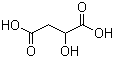 |
| Molecular Formula | C4H6O5 |
| Molecular Weight | 134.09 |
| CAS Registry Number | 6915-15-7 (617-48-1) |
| EC Number | 230-022-8 |
| SMILES | C(C(C(=O)O)O)C(=O)O |
| Solubility | 0.5 M (water, 20 °C) |
|---|---|
| Density | 1.609 g/mL |
| Melting point | 130 °C |
| Boiling point | 150 °C (decomp.) |
| Flash point | 203 °C |
| Hazard Symbols |  GHS07 Warning Details GHS07 Warning Details | ||||||||||||||||||||||||||||||||
|---|---|---|---|---|---|---|---|---|---|---|---|---|---|---|---|---|---|---|---|---|---|---|---|---|---|---|---|---|---|---|---|---|---|
| Risk Statements | H315-H319 Details | ||||||||||||||||||||||||||||||||
| Safety Statements | P264-P264+P265-P280-P302+P352-P305+P351+P338-P321-P332+P317-P337+P317-P362+P364 Details | ||||||||||||||||||||||||||||||||
| Hazard Classification | |||||||||||||||||||||||||||||||||
| |||||||||||||||||||||||||||||||||
| SDS | Available | ||||||||||||||||||||||||||||||||
 Discovery and Applications
|
Malic acid, a naturally occurring organic compound, was first isolated in 1785 by Swedish chemist Carl Wilhelm Scheele from unripe apples. The name malic is derived from the Latin word malum, meaning apple, reflecting its natural source. Scheele‘s discovery marked a significant advancement in organic chemistry, as malic acid became one of the earliest identified plant acids. Its chemical structure was later elucidated in the 19th century, revealing that malic acid is a dicarboxylic acid with two functional carboxyl groups. This compound plays a crucial role in the citric acid cycle (Krebs cycle), which is vital for cellular respiration in all aerobic organisms. Today, malic acid is recognized for its versatile applications in food, medicine, and cosmetics due to its tart flavor and beneficial properties. Malic acid is extensively used in the food industry as an acidulant to enhance flavor and preserve the freshness of various products. Its naturally tart taste is ideal for balancing sweetness and adding a tangy flavor to beverages, candies, and dairy products. In soft drinks and fruit juices, malic acid provides a longer-lasting sour taste compared to citric acid. It also acts as a pH regulator and preservative, helping to extend the shelf life of processed foods. Additionally, malic acid is used in confectionery to create sour candies and in baked goods to improve dough strength and texture. Malic acid is incorporated into nutritional supplements due to its role in the citric acid cycle, where it helps produce energy by aiding in the conversion of carbohydrates, fats, and proteins into carbon dioxide and water. This property makes malic acid a valuable component in energy-boosting supplements. It is also included in formulations for managing conditions like fibromyalgia and chronic fatigue syndrome (CFS), as it may help alleviate muscle fatigue and improve stamina. In cosmetics, malic acid serves as an alpha-hydroxy acid (AHA), known for its exfoliating properties. It is commonly used in skincare products to promote the shedding of dead skin cells, enhance skin texture, and improve overall complexion. Malic acid helps in reducing the appearance of fine lines, wrinkles, and hyperpigmentation, making it a key ingredient in anti-aging treatments. Its ability to maintain skin hydration and stimulate collagen production further supports its use in moisturizers and peels. Malic acid has therapeutic applications in oral health care. It is included in toothpaste and mouthwashes for its ability to stimulate saliva production, which helps maintain oral hygiene and prevent dry mouth. Additionally, malic acid's mild antimicrobial properties contribute to its use in treating bad breath and oral infections. Its role in the citric acid cycle also supports its use in managing metabolic acidosis, a condition where the body produces excessive acid or when the kidneys are not removing enough acid from the body. In agriculture, malic acid is used to adjust soil pH, making it more conducive to plant growth. It can act as a chelating agent, helping to make essential minerals more available to plants. In environmental applications, malic acid helps in metal cleaning and as a natural descaling agent due to its ability to dissolve mineral deposits. Malic acid is employed in various industrial processes. It is used in the production of biodegradable polymers and plasticizers. It also serves as a buffering agent in pharmaceutical formulations, helping to stabilize the pH and enhance the solubility of active ingredients. References 2024. The role of citric acid and enzyme activities on sourness in pineapple fruit after low temperature storage. Horticulture, Environment, and Biotechnology, 65(6). DOI: 10.1007/s13580-024-00660-0 1998. Mechanism of the Protective Effect of Sodium Malate on Cisplatin-Induced Toxicity in Mice. Biological and Pharmaceutical Bulletin, 21(2). DOI: 10.1248/bpb.21.121 1984. Kinetic mechanism in the direction of oxidative decarboxylation for NAD-malic enzyme from Ascaris suum. Biochemistry, 23(22). DOI: 10.1021/bi00318a011 |
| Market Analysis Reports |