
Online Database of Chemicals from Around the World
| Hangzhou Verychem Science And Technology Co., Ltd. | China | |||
|---|---|---|---|---|
 | www.verychem.com | |||
 | +86 (571) 8816-2785 +86 13606544505 | |||
 | +86 (571) 8816-2787 | |||
 | lucy@verychem.com | |||
| Chemical manufacturer since 2004 | ||||
| chemBlink Massive supplier since 2021 | ||||
| Xuzhou Xbetop Biotechnology Co., Ltd. | China | |||
|---|---|---|---|---|
| www.xbetop.com | |||
| +86 (516) 8329-1698 | |||
| +86 (516) 8329-1698 | |||
| xbetop@gmail.com xbetop@hotmail.com | |||
 | QQ Chat | |||
| Chemical manufacturer | ||||
| chemBlink Standard supplier since 2011 | ||||
| Labseeker Inc | USA | |||
|---|---|---|---|---|
| www.labseeker.com | |||
| +1 (858) 750-1632 | |||
| +1 (858) 412-1220 | |||
| marketing@labseeker.com | |||
| Chemical manufacturer since 2002 | ||||
| chemBlink Standard supplier since 2015 | ||||
| Classification | Organic raw materials >> Amino compound >> Acyclic monoamines, polyamines and their derivatives and salts |
|---|---|
| Name | 1-(3-Dimethylaminopropyl)-3-ethylcarbodiimide hydrochloride |
| Synonyms | N-(3-Dimethylaminopropyl)-3-ethylcarbodiimide hydrochloride; N-[3-(Dimethylamino)propyl]-N'-ethylcarbodiimide hydrochloride |
| Molecular Structure | 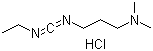 |
| Molecular Formula | C8H17N3.HCl |
| Molecular Weight | 191.70 |
| CAS Registry Number | 7084-11-9 |
| EC Number | 230-383-1 |
| SMILES | CCN=C=NCCCN(C)C.Cl |
| Melting point | 110-115 °C |
|---|---|
| Hazard Symbols |      GHS05;GHS06;GHS07;GHS08;GHS09 Danger Details GHS05;GHS06;GHS07;GHS08;GHS09 Danger Details |
|---|---|
| Risk Statements | H302-H311-H315-H317-H318-H319-H335-H373-H400-H410 Details |
| Safety Statements | P260-P261-P262-P264-P264+P265-P270-P271-P272-P273-P280-P301+P317-P302+P352-P304+P340-P305+P351+P338-P305+P354+P338-P316-P317-P319-P321-P330-P332+P317-P333+P317-P337+P317-P361+P364-P362+P364-P391-P403+P233-P405- Details |
| SDS | Available |
 chemBlink Chemical Story
|
1-(3-Dimethylaminopropyl)-3-ethylcarbodiimide hydrochloride, commonly known as EDC hydrochloride, was first synthesized and characterized for use in peptide synthesis by Sheehan and Hess in the early 1950s. The synthesis involved the reaction of N,N'-dicyclohexylcarbodiimide (DCC) with N,N-dimethylaminopropylamine followed by acidification to produce the hydrochloride salt. This discovery marked a major advance in peptide chemistry, making peptide bond formation more efficient and selective. EDC hydrochloride is a water-soluble crystalline compound with the chemical formula C8H17N3·HCl. It consists of a carbodiimide functional group (-N=C=N-) attached to a three-carbon chain, one of which is ethylated and the other substituted with a dimethylaminopropyl group. This structure makes it water-soluble and reactive under mild aqueous conditions, making it suitable for biochemical applications. EDC hydrochloride is primarily used in peptide synthesis to couple the carboxyl group (-COOH) of an amino acid or peptide with a primary amine (-NH2). This coupling reaction forms a stable amide bond (-CONH-) that does not undergo racemization, which is essential for the synthesis of peptides, proteins, and conjugates in pharmaceutical research and biotechnology. In biochemical and biomedical research, EDC hydrochloride is used as a cross-linker to covalently link carboxyl and amino groups in proteins, nucleic acids, and synthetic polymers. This cross-linking enhances structural stability, changes surface properties, and facilitates the use of biomaterials in tissue engineering and drug delivery systems. The compound immobilizes biomolecules, such as enzymes and antibodies, on solid supports or surfaces for use in bioanalytical assays, biosensors, and diagnostic devices. This immobilization strategy improves biomolecule stability, enhances detection sensitivity, and enables rapid bioassay development in the clinical diagnostics and biopharmaceutical industries. Ongoing research explores advanced applications of EDC hydrochloride for: development of bioconjugates and prodrugs with enhanced pharmacokinetic profiles and targeted delivery capabilities; design of biomaterial scaffolds and tissue engineering constructs for regenerative therapies and surgical implants; and functionalization of nanoparticles using EDC-mediated conjugation to improve drug loading efficiency and therapeutic efficacy in nanomedicine. EDC hydrochloride is handled under controlled laboratory conditions due to its irritation and potential sensitization effects. Regulatory guidelines govern its manufacture, storage, and disposal to ensure occupational safety, environmental protection, and compliance with global chemical regulations. References 2017. Construction and biocompatibility of a thin type I/II collagen composite scaffold. Cell and Tissue Banking, 18(4). DOI: 10.1007/s10561-017-9653-2 2013. Exploring Advantages/Disadvantages and Improvements in Overcoming Gene Delivery Barriers of Amino Acid Modified Trimethylated Chitosan. Pharmaceutical Research, 32(4). DOI: 10.1007/s11095-014-1597-7 2012. Formulation and In Vitro Characterization of Composite Biodegradable Magnetic Nanoparticles for Magnetically Guided Cell Delivery. Pharmaceutical Research, 29(6). DOI: 10.1007/s11095-012-0675-y |
| Market Analysis Reports |