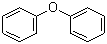
Diphenyl ether is a simple molecule with an unusually important thermal-engineering career. Two benzene rings are connected by one oxygen atom, giving a stable aromatic liquid with a relatively high boiling point and lower melting behavior than many larger rigid aromatics. On its own that is useful, but its most famous role appears when it is mixed with biphenyl.
The diphenyl ether/biphenyl mixture illustrates eutectic chemistry in practical form. A pure crystalline substance melts at a temperature set by how efficiently its molecules pack into a solid lattice. Mixing a second component can frustrate that packing and lower the melting point. The commercial heat-transfer fluids historically known as Dowtherm A and, in modern formulations, Therminol VP-1 exploit a composition close to the eutectic of diphenyl ether and biphenyl. The fluid can circulate as a liquid over a broad temperature range while retaining the thermal stability of aromatic molecules.
That combination made the mixture important in high-temperature process heating and later in concentrating solar power. In a solar thermal plant, mirrors focus sunlight onto a receiver and the heat-transfer fluid carries that energy to a steam generator or storage system. A fluid must resist decomposition during repeated hot cycles, avoid excessive vapor pressure, and remain pumpable during cooler periods. Diphenyl ether contributes to a compromise between those requirements rather than providing one perfect property by itself.
The molecule is also interesting structurally. The two phenyl rings are not locked into one flat plane; rotation around the aryl-oxygen bonds changes their relative orientation. The ether oxygen interrupts the direct carbon-carbon connection found in biphenyl and modifies electronic communication between the rings. That difference affects physical properties, intermolecular packing, and reactivity, which is why diaryl ether linkages recur in polymers, pharmaceuticals, and natural products even though the parent compound itself is chemically modest.
Thermal fluids age. At elevated temperature, aromatic heat-transfer mixtures can undergo cracking, dealkylation, coupling, and formation of higher-boiling products. Industrial systems therefore monitor fluid composition and thermal history instead of assuming that a fill of heat-transfer liquid lasts forever. Modern thermophysical studies continue to measure viscosity, density, heat capacity, and phase behavior because small errors in those properties can affect pump sizing and heat exchanger design.
Diphenyl ether is memorable because its importance comes from partnership. Mixed with biphenyl, it demonstrates how phase equilibria can turn two ordinary aromatic compounds into an engineered thermal medium. The story is less about a spectacular chemical reaction than about using molecular packing, melting behavior, and stability to solve a large-scale energy-transport problem.
References:
1. NIST Chemistry WebBook. Diphenyl ether, CAS 101-84-8.
2. Velez C., Khayet M., Ortiz de Zarate J.M. Thermophysical properties of (diphenyl ether + biphenyl) mixtures for their use as heat transfer fluids. Journal of Chemical Thermodynamics. 2012, 50, 80-88. DOI: 10.1016/j.jct.2012.02.001.
3. RIFM. Safety assessment of diphenyl ether. Food and Chemical Toxicology. 2019. DOI: 10.1016/j.fct.2019.110632.
4. Literature on diphenyl ether/biphenyl thermal media in concentrating solar power. ACS Sustainable Chemistry & Engineering. 2020. DOI: 10.1021/acssuschemeng.0c05648.
|






 GHS07;GHS09 Warning Details
 chemBlink Chemical Story