Salicylhydroxamic acid, usually abbreviated SHAM, is best known not as a medicine but as a biochemical switch. It inhibits alternative oxidase, a terminal respiratory enzyme found in plants, fungi, and some protists but absent from the standard mammalian mitochondrial respiratory chain. By adding SHAM and watching oxygen consumption change, researchers gained a practical way to separate alternative respiration from the classical cytochrome pathway.
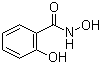
The molecule combines a salicyl aromatic ring with a hydroxamic acid group. Hydroxamates bind metals strongly, and alternative oxidase contains a non-heme diiron active site. SHAM inhibits the enzyme through interactions associated with this metal-containing catalytic center. The compound is not perfectly selective in every biological system, so experimental interpretation requires appropriate controls, but its historical importance as an alternative-oxidase probe is substantial.
Alternative oxidase creates a respiratory bypass. Electrons from the ubiquinone pool can flow directly to oxygen through AOX without passing through complexes III and IV. This pathway produces less proton-motive force and therefore less ATP than the cytochrome route, but it can keep electron transport moving when the main pathway is constrained. In plants it contributes to metabolic flexibility during stress, temperature changes, and situations where carbon metabolism and ATP demand become mismatched.
The same target attracted antiparasitic research because some pathogens depend strongly on alternative oxidase. Trypanosoma brucei bloodstream forms, for example, rely on a trypanosome alternative oxidase. SHAM showed that inhibiting this pathway could be biologically important, but its potency and pharmacological properties were insufficient for practical therapy. More potent inhibitors such as ascofuranone and later mitochondrion-targeted compounds turned the early SHAM experiments into a starting point for modern target-based drug discovery rather than an endpoint.
SHAM matters because it demonstrates the value of a chemical probe. A reagent does not have to become a successful drug to transform biology. By selectively perturbing one respiratory branch, salicylhydroxamic acid helped researchers ask how much oxygen consumption travels through an alternative pathway, when organisms use that bypass, and whether pathogens can survive without it. Its greatest contribution is therefore experimental: it made an otherwise hidden branch of respiration chemically visible.
References:
Ebiloma GU et al. Medicinal Research Reviews. 2019;39:1553-1602. DOI: 10.1002/med.21560.
Berthold DA. Biochimica et Biophysica Acta. 1998;1364:73-83. DOI: 10.1016/S0005-2728(98)00015-2.
Moore AL, Siedow JN. Biochimica et Biophysica Acta. 1991;1059:121-140. DOI: 10.1016/S0005-2728(05)80197-5.
|







 GHS07;GHS08 Warning Details
 chemBlink Chemical Story